Astronomer
- Fun pictures /
- People /
- Astronomer

Did you know the word "astronomer" comes from Greek roots meaning "star" and "law"? It basically means someone who studies the rules of the stars. Astronomers helped us discover that Earth isn’t the center of the universe—a big deal back in the day! Galileo, one of the most famous astronomers, improved the telescope and saw moons around Jupiter, changing how we see space.

Astronomers don’t just look at stars; they study everything in space—planets, galaxies, black holes, and even cosmic dust. The Hubble Space Telescope, launched by astronomers, has taken pictures of galaxies billions of light-years away. Astronomers often use light years to measure distances because space is too huge for miles or kilometers.

Ancient astronomers used simple tools like sundials and astrolabes to track the stars and predict seasons. Some astronomers believe the first stargazers might have been early humans marking time and navigation. Modern astronomers often use radio waves, not just visible light, to explore the universe.
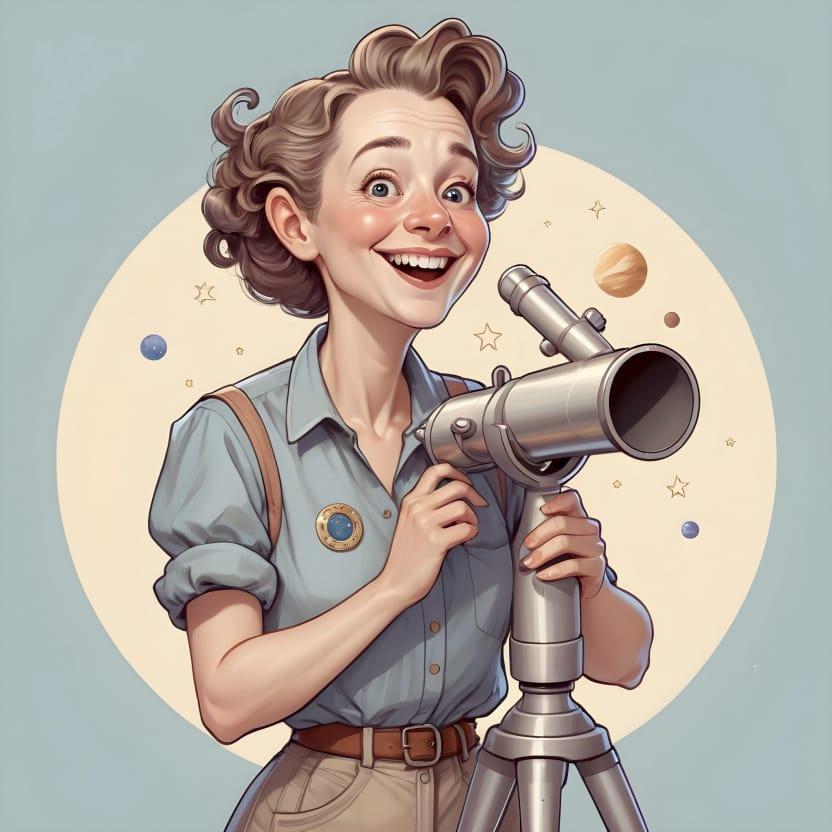
An astronomer’s work isn’t just in observatories—many analyze data from computers and satellites. Astronomers helped confirm that the universe is expanding, leading to the Big Bang theory. Famous astronomer Carl Sagan made space science popular by explaining complex ideas in simple ways.

Some astronomers specialize in studying stars, while others focus on planets or galaxies—there’s a lot of specialties! Astronomers found exoplanets, which are planets orbiting other stars, proving Earth isn’t unique. Space telescopes have to orbit Earth because our atmosphere blocks some important light astronomers want to see.

Astronomers once thought the Milky Way was the entire universe until they discovered other galaxies. Many astronomers work in teams worldwide, sharing data to solve cosmic mysteries. Being an astronomer often means working odd hours since space objects don’t wait for daytime.

Astronomers helped map the cosmic microwave background—the leftover heat from the Big Bang. The largest telescopes astronomers use can be as big as a house and need special mirrors to work. Astronomers have found stars that lived before our Sun, giving clues about the universe’s age.

Astronomers helped prove that black holes exist, mysterious points with gravity so strong nothing escapes. The first woman astronomer known by name was Hypatia, who lived in ancient Alexandria over 1,600 years ago. Some astronomers study meteor showers to learn about comets and asteroids near Earth.

Astronomers use spectrometers to break light into colors, revealing what stars are made of. Amateur astronomers sometimes discover new comets or supernovae, showing astronomy is for everyone. Astronomers learned that stars are born in huge clouds called nebulae.

Astronomers track asteroids to assess any potential threats to Earth. The fastest known star astronomers found is moving at over a million miles per hour! Astronomers believe dark matter makes up most of the universe, but it’s invisible and mysterious.

Some astronomers study pulsars—spinning neutron stars that send out radio signals like cosmic lighthouses. Astronomers once thought our solar system had nine planets, but now Pluto is classified as a dwarf planet. Using data from astronomers, scientists have calculated that the universe is about 13.8 billion years old.

Astronomers rely on supercomputers to simulate how galaxies form and evolve over billions of years. Many astronomers believe that life might exist on moons like Europa or Enceladus because of hidden oceans. The “golden age” of astronomy happened in the 20th century with many discoveries thanks to new technology.

Astronomers helped develop GPS technology by understanding how satellites move and how time works in space. The James Webb Space Telescope, used by astronomers, will look further back in time than ever before. Some astronomers study the sun to better predict solar storms that can disrupt Earth's technology.

Astronomers discovered that galaxies collide and merge, shaping the structure of the universe. The first astronomers tracked planets without knowing they were planets, calling them “wandering stars.” Astronomers sometimes name newly found stars and planets based on mythology or scientists.

Astronomers use infrared telescopes to see through cosmic dust that blocks visible light. Space missions planned by astronomers include sending telescopes to other planets to study their skies. Astronomers study gravity waves—ripples in space-time caused by massive cosmic events.

Astronomers use binary star systems to measure the mass of stars by watching how they orbit each other. The Crab Nebula is a famous cosmic object first recorded by astronomers in 1054 AD during a supernova. Astronomers are still trying to understand mysterious fast radio bursts from distant space.

Astronomers work closely with physicists to understand phenomena like black holes and neutron stars. Many early astronomers were also astrologers, though the two fields now are very different. Astronomers helped discover cosmic elements like helium by analyzing sunlight.

The biggest black hole astronomers have found is billions of times more massive than our Sun. Astronomers have observed that some stars explode as supernovae, spreading elements needed for life. Some astronomers believe rogue planets wander through space without orbiting stars.

Astronomers use lasers to measure the distance to the Moon with incredible precision. Thanks to astronomers, we know that the nearest star after the Sun is Proxima Centauri, about 4.2 light-years away. Astronomers have mapped the surface of Mars with orbiters, helping plan future human missions.

Astronomers discovered cosmic microwave background radiation, a key proof of the Big Bang. The oldest light astronomers can see comes from nearly 14 billion years ago, right after the universe began. Some astronomers spend years just looking at data from telescopes, hunting for tiny signals from the cosmos.